This is why a personalized
program is so important - it suits YOU.
Other benefits: improve
overall fitness levels, breathing, posture, motor skills, flexibility,
technique. Share with friends for extra motivation and fun.
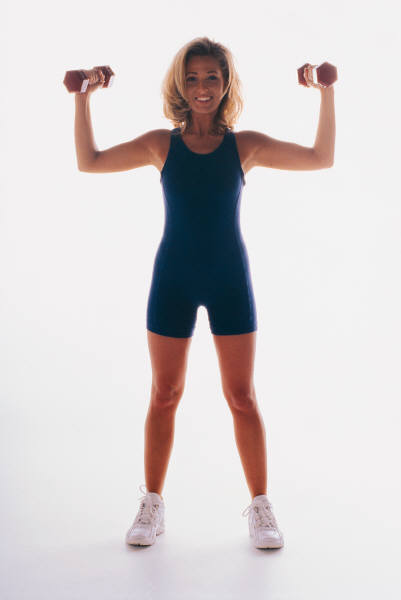
Resistance Training
Flexibility Training
Flexibility is another important component of fitness.
It is defined as the range of motion possible around a joint. Flexibility
training should be included in all fitness programming to prevent loss of joint
mobility and to prevent injury to muscle, connective tissue and joints, which
may result from this loss. Flexibility is important for the proper functioning
of the spine; tight erector spinae, hamstring, and illiopsoas muscles have all
been implicated as possible causes of low back pain. Lack of flexibility is one
of the causes of Lordosis, an anterior pelvic tilt and an excessive lumbar
curve, also called swayback. Another postural deviation due to lack of
flexibility is Kyphosis, a hunched upper back. Flexibility sessions can be
combined with all training sessions. A fitness assessment will determine the
condition of each client's current flexibility.
Cardiovascular Training
Cardiovascular
fitness training, also known as aerobic training, is sustained exercise
involving the large muscle groups. This exercise should increase the heart rate
to a designated range called the target heart range or exercise heart range.
Sometimes you will see the terms "rate" or "range" used interchangeably but
"range" is generally a scope of numbers which encompass the more specific
"rate," which is usually one number.
No matter which term is used, a range
of goal numbers for the target or exercise heart rate is usually the best method
of actually monitoring one's heart rate during activity. It is difficult to
maintain and remain at one specific heart rate number. A range allows an
individual to readily monitor his/her own target heart rate while exercising.
Some good examples of cardiovascular
fitness activities include, but are not limited to, brisk walking, biking,
running, swimming, cross country skiing, in-line skating, aerobic dance, and
stepping. It does not matter if you do your workout indoors or out, on a
machine or not. It doesn't even matter if you do a variety of different
cardiovascular workouts. This is called cross training and it is an effective
way to vary your cardiovascular workouts.
|
The bottom-line goal is to raise your
heart rate to your target range, keep it there for thirty minutes, and do this
at least three times per week. Make sure if you are doing an activity like
swimming or in-line skating, that your skill level is sufficient enough to allow
you to do a proper cardiovascular workout. Start/stop activities, such as
tennis, racquetball, and basketball, are great supplemental workout fun, but do
not provide enough sustained time in the target heart range to be used as your
primary means of cardiovascular fitness.
In order to gain the benefits of
cardiovascular training, one must do this sustained activity of the large muscle
groups for a minimum of twenty to thirty minutes at least three times per week.
This minimum is recommended only after safely building to this level.
Your target heart range is most
accurately calculated in a laboratory setting but this is not feasible for the
general public. Using a general formula, you can calculate your target heart
range using your age, resting heart rate, and approximate fitness level. It is
important to note that general guidelines based solely on a person's age and
fitness level are guidelines only. These guidelines are frequently posted in
health clubs and on fitness equipment.
It is best to calculate your own
target heart range using your individual resting heart rate since resting heart
rates can vary significantly even among people of the same age. Many factors
such as hereditary tendencies, medical conditions, and even common medications
can affect one's resting heart rate. |
 |